
Defense Industrial Base Risk Is Bigger Than a Vendor List
On September 3, 2026, a senior Pentagon official confirmed that Anthropic remains classified as a "Supply Chain Risk" to the defense industrial base, despite reports of warming ties between the AI company and the administration, according to Reuters. The classification itself is routine risk management. What it signals is less routine: the Pentagon is actively expanding what it treats as a threat to defense production capacity, at the same time it is standing up new offices and procurement reforms aimed at exactly that capacity. That raises a fair question for fabricators: if software vendors get this level of scrutiny, why does quality still get treated as a downstream problem instead of a production capacity risk?
Here are five beliefs about weld quality and defense fabrication that are blocking production capacity today.
Myth: Supply chain risk is mostly a vendor and software problem
The Anthropic designation is about AI tooling access, but the same DoW apparatus pushing that classification is also pushing acquisition reform and new industrial base offices, including the Navy's newly created Office of the Defense Industrial Base under Andrew Magliochetti, according to Breaking Defense. That office exists because capacity risk is broader than any single vendor list. A fabricator that reworks a percentage of its multi-pass welds after 100% volumetric testing is a capacity risk in exactly the same structural sense: it is a bottleneck between contract award and delivered hardware, whether or not anyone puts it on a supply chain risk register.
Myth: 100% volumetric testing means defects get caught before they matter
100% volumetric testing means every completed weld gets inspected. It does not mean every defect gets caught cheaply. On multi-pass welds under AWS D1.1, AWS D1.5, or NAVSEA S9074 requirements, porosity, incomplete penetration, lack of fusion, and slag inclusions that form in an early pass get buried under three, five, or ten subsequent passes. UT or RT at the end of the joint finds the defect, but by then the fix means gouging out passes that were completed correctly just to reach the one that wasn't. The inspection did its job. The cost structure it created is the problem.
Myth: A defect caught by volumetric testing costs the same as one found during welding
It does not, and this is the gap the Pentagon's own procurement pressure is implicitly acknowledging. The push to speed weapons production amid shrinking stockpiles, described in coverage of the Iran war's effect on procurement transformation from Washington Examiner, depends on schedule reliability at the fabrication level. A defect caught while the arc is running gets corrected in the same pass, by the welder who made it, with full knowledge of joint geometry and heat history. A defect caught at final volumetric testing gets a nonconformance report, a root cause investigation, requalification of repair procedure if needed, and a CWI review cycle before rework even starts. Same defect, radically different cost and radically different schedule impact.
Myth: Weld quality risk is a shipyard-level problem, not an industrial base problem
It scales the wrong way to be a shipyard-only problem. The submarine industrial base, naval repair yards, and nuclear fabrication all run under 100% volumetric testing regimes precisely because a single missed defect has consequences well beyond one hull or one vessel. When new welders are entering the base, such as the seventeen graduates recently recognized by the Institute for Advanced Learning and Research as submarine-ready hires, per the Winston-Salem Journal, the industrial base is betting on their judgment holding up under exactly the multi-pass, buried-defect conditions where inexperience shows up as rework. Treating that as a training problem alone ignores that the feedback loop for a welder learning on the job is currently the same slow, after-the-fact loop that burns schedule for everyone else.
Myth: More oversight offices fix the throughput problem
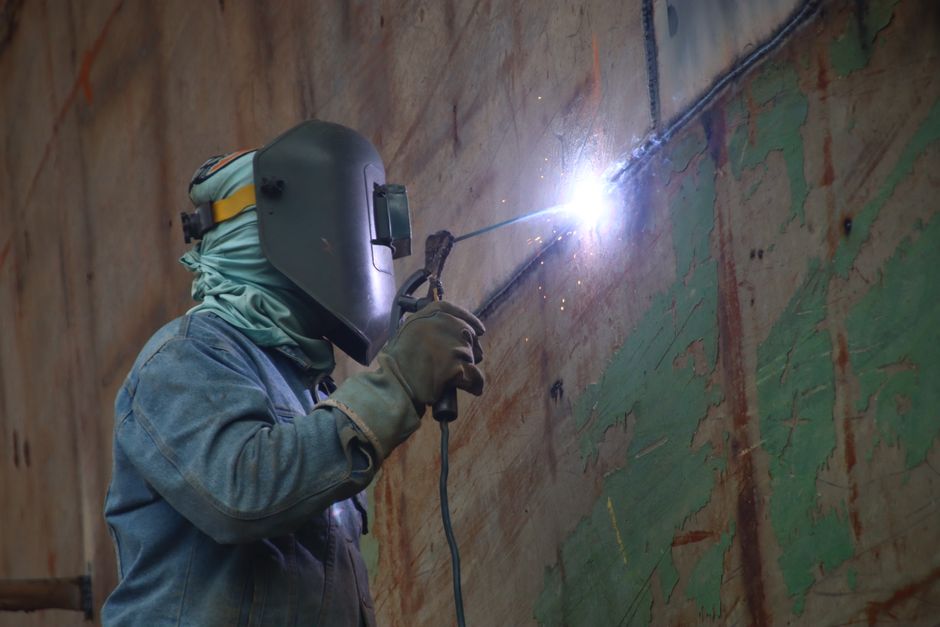
New industrial base offices and procurement reform can redirect funding and set priorities, but they do not put eyes on the arc. Throughput on multi-pass welds under code compliance is decided at the joint, in real time, by whether a defect is caught while it is still one bead deep or three passes buried. That is the layer where Sonibel Instruments operates. Sonibel's retrofit acoustic sensor sits near the arc and uses machine learning to flag porosity, incomplete penetration, lack of fusion, and slag inclusions as they form, alerting the welder during the pass instead of after the joint is closed out. It functions as an in-process, pre-volumetric testing quality gate, not a replacement for UT, RT, CWI review, or code-required inspection. Those remain the record of compliance. Sonibel changes what happens before that record gets written, catching the correctable defect before it becomes a buried one.
For a fabricator running multi-pass work under 100% volumetric testing, that shift moves rework decisions to the point where they are cheapest to make and least disruptive to schedule, which is precisely the kind of capacity risk the defense industrial base is now organizing new offices to manage. The tools for managing AI vendor risk and procurement risk are still catching up to a policy conversation. The tool for managing weld quality risk at the arc already exists today.
Contact sophia@sonibelinstruments.com to learn more about Sonibel Instruments' real-time acoustic weld monitoring system.